

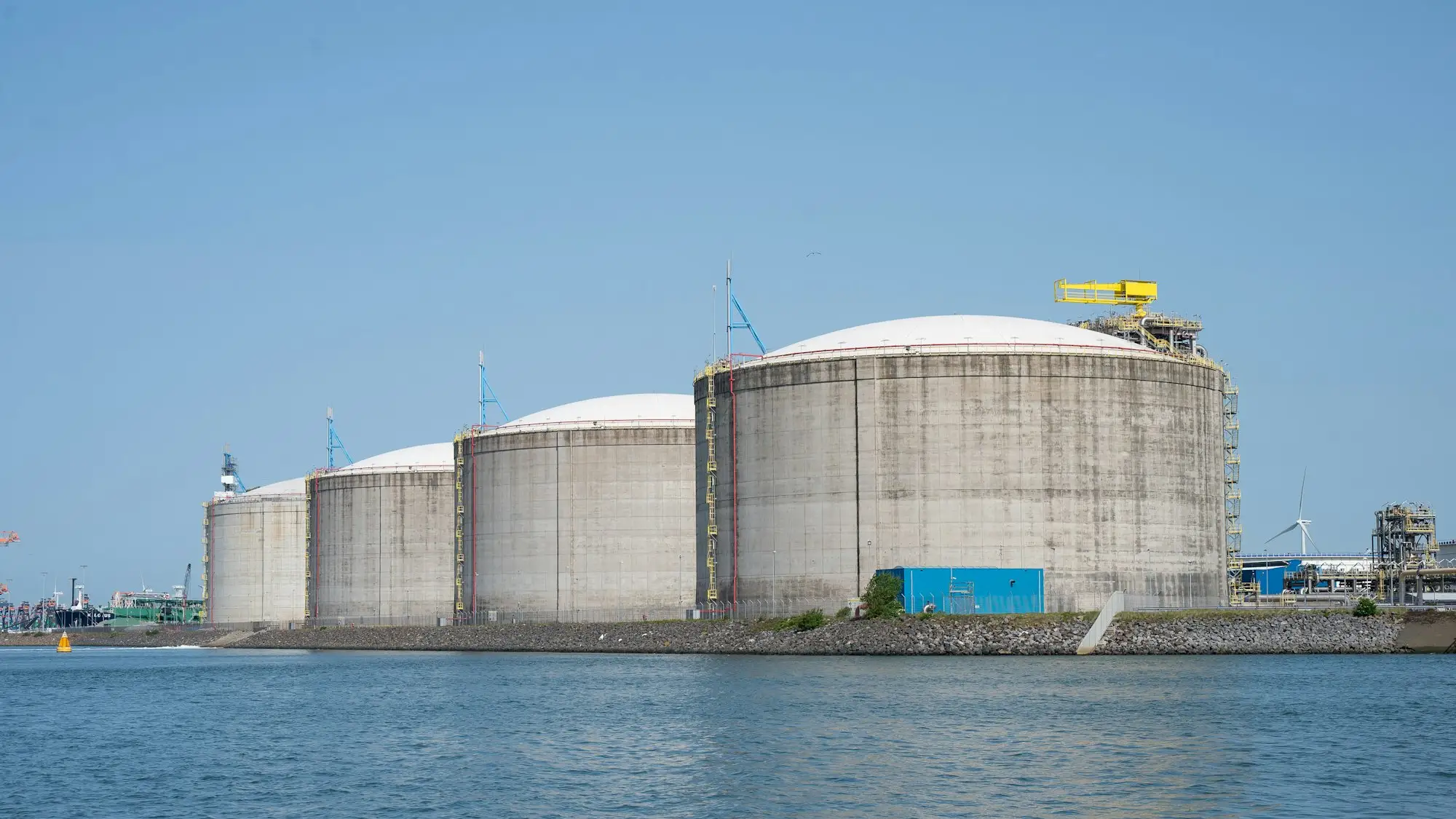
Energy
LNG sourcing and trading
ROXAY Trading sources and trades liquefied natural gas (LNG) for importers, power utilities and industrial consumers in markets that receive gas by sea.
At a glance
- Category
- Energy
- Typical buyers
- Importers, power utilities, industrial consumers, distributors
- Delivery form
- Seaborne, to regasification or receiving terminals
- Common Incoterms
- FOB, CIF, CFR — set per transaction
- Priority markets
- China, India, Pakistan, Africa, wider Asia
Liquefied natural gas is natural gas cooled to roughly minus 162 degrees Celsius, at which point it becomes a liquid occupying around one six-hundredth of its gaseous volume. That reduction is what makes it shippable — and it is the reason LNG exists as a traded commodity at all.
ROXAY Trading sources and trades LNG for buyers in markets that receive gas by sea rather than through a pipeline network.
Where LNG fits
For an importing country, LNG is the answer to a geographic problem. Pipeline gas requires a fixed physical connection to a producing region and a long-term political relationship to go with it. LNG replaces that connection with a shipping route, which can be changed.
This is why LNG demand concentrates in exactly the markets ROXAY serves: import-dependent economies across Asia and Africa building power generation and industrial capacity faster than domestic gas supply can support.
Who buys it
Power utilities buying fuel for gas-fired generation. Industrial consumers running processes where gas is either the energy source or the feedstock. Importers and distributors supplying a domestic market downstream. Commodity traders taking a position between the two.
What these buyers share is that the cost of interrupted supply is far higher than the difference between a good price and an excellent one.
What a buyer needs to define
An LNG enquiry needs four things before supply can be qualified:
- Receiving point — the discharge port or regasification terminal. This is the constraint that decides whether the trade is possible at all.
- Volume — per cargo, and whether the requirement repeats.
- Delivery window — LNG cannot be held indefinitely; timing is part of the specification.
- Incoterm — whether shipping sits with the buyer or the seller.
Specification detail such as heating value and composition matters as well, particularly where the receiving terminal or the end use has a narrow tolerance.
How ROXAY handles an LNG trade
We qualify available supply against the specification and window, confirm that the receiving point can take the cargo, structure the commercial terms and coordinate the contract and delivery sequence with both counterparties.
We do not operate carriers or terminals, and we do not present ourselves as if we did. Shipping is arranged per transaction against the agreed Incoterm.
We do not publish origin countries, suppliers or routes.
Questions buyers ask
Does ROXAY Trading supply LNG on FOB or CIF terms?
Both are workable. FOB places the shipping arrangement with the buyer, CIF places it with the seller; which one applies depends on the route, the buyer's chartering capability and what both counterparties can support. The Incoterm is agreed per transaction.
What information is needed to quote an LNG requirement?
The discharge port or receiving terminal, the volume, the delivery window and the preferred Incoterm carry the most weight. Without a defined receiving point an LNG enquiry cannot be qualified, because not every market can physically take a seaborne cargo.
Can ROXAY arrange a single LNG cargo rather than a term contract?
Yes. Single-cargo and recurring supply are both possible. Which structure works better depends on the buyer's consumption profile and how much certainty they need over the delivery window.
Does ROXAY own LNG carriers or terminals?
No. ROXAY Trading positions itself on its commercial network and sourcing capability rather than on owned assets. Shipping is organised per transaction according to the agreed delivery terms.
More in Energy
LPG
ROXAY Trading sources and trades liquefied petroleum gas (LPG) — propane, butane and their mixes — for importers, distributors and industrial consumers.

Natural Gas
ROXAY Trading sources and trades natural gas for industrial consumers, power generators and importers, alongside LNG and other energy and hydrocarbon products.